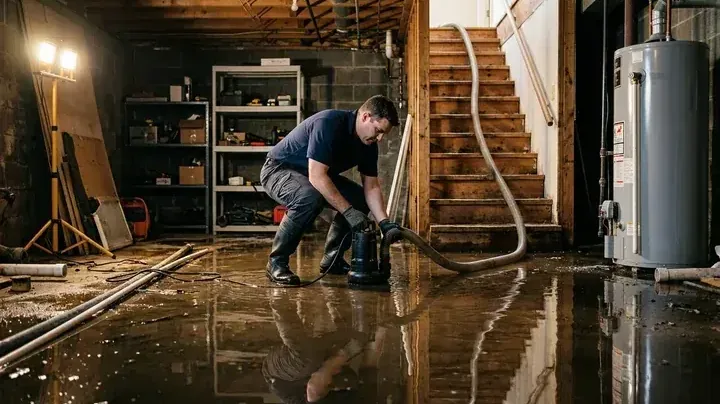
Basement water looks the same on the floor, but its cause decides everything that follows. The source determines what is pulled out, how fast it must move, and whether the cleanup treats the water as clean or contaminated.
Key takeaways
- A basement takes on water from seepage, a sump pump that stopped, a floor drain or outside water, and each source changes the cleanup.
- Naylors Run and Meadowbrook Run sit beside Cobbs Creek and Darby Creek in Haverford Township, so one heavy rain has several waterways to fill.
- Water left standing for a day or two can slide into a worse category, because materials start to hold bacteria and odor.
- The FEMA Flood Map Service Center and the PA Flood Risk Tool let a homeowner look up a property before the next storm, though neither one gives a final flood determination.
- Wet carpet, pad and lower drywall come out first, and the slab and block walls dry afterward with dehumidifiers.
Four ways water gets into a basement
Before any pump or mop comes out, it helps to name the source. The four common ones leave different clues.
A wrong guess costs time, because a clean seep and a sewage backup are cleaned in very different ways.
Seepage through walls and floors
Water that creeps through a wall joint or rises through a crack in the slab is usually clear and shows up along the edges of the room. Damp patches grow slowly and often return in the same spot after each long rain.
A sump pump that quit
A pump can fail from a power outage, a stuck float, a blocked discharge pipe or simple wear. When it does, the pit overflows and the water spreads from one corner.
A sump pump failure cleanup is a clean water job if it is caught early.
A floor drain that backs up
Water that rises through a floor drain, a basement toilet or a tub is not clean. It can be sewage, and it is cleaned as contaminated water.
Outside water from a creek or a storm
Water that comes through a window well, a door or a wall during a storm carries soil and runoff. It is also treated as contaminated.
The waterways and dates behind local basement risk
Cobbs Creek and Darby Creek mark parts of the township boundaries, and Naylors Run and Meadowbrook Run join them as named waterways. August 1955 and June 1972 brought record flooding to eastern Pennsylvania.
The township grew out of communities such as Brookline, Beechwood, Oakmont, Manoa and Llanerch, with Brookline built in 1909 as the most fully developed railroad suburb. The major housing tracts came after World War II with Chatham Park.
Whatever the era of the house, a basement sits below the surrounding grade, which makes it the first place that water collects.
Reading the water before touching it
The color, smell and path of the water give the restoration team a first read. A photo and a short note on each help the insurer later.
- Clear water with no odor usually points to seepage or a supply pipe.
- Cloudy or gray water suggests it has crossed floors, appliances or soil.
- Dark water with a sewage smell, or any water from a drain, is handled as Category 3.
- Water that appeared during a storm and carries mud is handled as contaminated, even though it came from rain.
What gets pulled out and what stays
The crew starts with water extraction, using pumps for deep water and wet vacuums for the film that remains. Anything that wicks water upward comes next.
A full basement flooding cleanup usually removes the materials that cannot be dried reliably and keeps the ones that can.
- Carpet and pad are removed, and sometimes salvaged only when the water was clean and caught early.
- Drywall is cut a few inches above the wet line, or higher where the wicking climbed.
- Baseboards and trim are pulled so the wall cavity can breathe.
- Cardboard boxes, paper files and upholstered items that stayed wet are discarded.
- Concrete, block and sound framing stay and are dried.
Mistakes that make basement water worse
A few well meant steps cause extra damage, and most of them happen in the first hour. They are easy to avoid once they are named.
- Walking into a flooded room with the power still on.
- Using a household vacuum on standing water, which is a shock risk and a motor killer.
- Leaving wet carpet in place for a few days to see if it dries.
- Turning the heat up to dry the room, which can speed the growth of mold in wall cavities.
- Moving wet boxes into dry rooms where they spread moisture.
Drying the slab and block walls
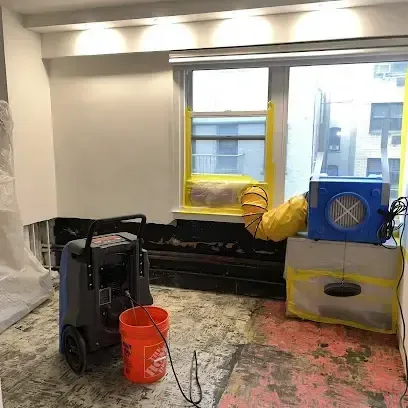
Concrete and block hold moisture longer than most people expect, so a floor that looks dry can still read wet. Dehumidifiers run in the closed space while air movers push dry air across the surfaces.
Structural drying is complete when the readings reach the dry reference for each material, which is usually a matter of days rather than hours. A finished basement with framing and drywall takes longer than a bare one.
Looking up a property before the next storm
Two public tools help a homeowner see the setting before a wet season. The FEMA Flood Map Service Center shows flood maps, and the PA Flood Risk Tool builds a property report with flood zone, risk type and the watershed stream.
The PA Flood Risk Tool is not the source for a final flood determination, so treat the result as a starting point and ask the township or the insurer for the official answer.
- Look up the street address in both tools and save a copy of each result.
- Note any mention of a nearby stream or run.
- Ask the insurer whether flood damage is covered or needs a separate policy.
- Move stored items off the basement floor in the months when storms are likely.
Questions
How can I tell if basement water is from a sump pump failure?
Look at the pit. If it is full or overflowing, the pump is silent or humming without moving water, and the floor is wettest near the pit, the pump is the likely cause. Water that appears evenly along the walls points to seepage instead.
Is basement water from a floor drain dangerous?
It can be. Water that rises from a drain may include sewage, which carries bacteria. Keep people and pets out, avoid touching it without gloves and boots, and have it removed as contaminated water.
How soon should wet drywall come out?
If the water was contaminated, drywall that wicked it up is removed right away. For clean water, it can sometimes be dried in place if it is caught early, but readings decide, not appearance.
Does a dehumidifier from a hardware store dry a flooded basement?
It helps with humidity, but it cannot pull moisture out of concrete, block and framing fast enough on its own. Restoration equipment moves far more air and is monitored with meters.
Can the flood tools tell me if my basement will flood?
They show flood zone and risk information for a property, but they do not predict a specific storm. Use them to plan, and use the insurer to learn what coverage applies.
Should I turn off the power to a wet basement?
Only if the main panel and the shutoff can be reached from dry ground. If water is near the panel or an outlet, stay out and ask the electric utility or an electrician to shut power off safely.