Structural Drying and Dehumidification in Havertown, PA
Structural drying removes the water that soaked into framing, subfloor, plaster and foundation walls. The drying team sizes air movers and LGR dehumidifiers to the class of loss and logs readings until materials reach a dry reference.
(888) 557-1733Walls still wet after the leak? Call now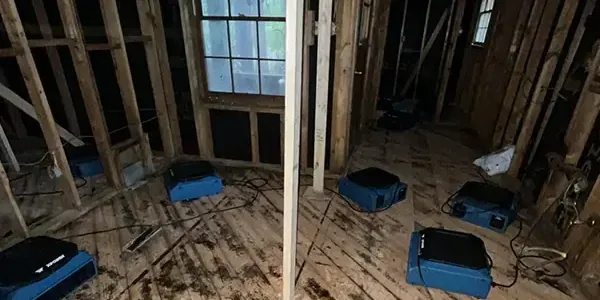
What every structural drying and dehumidification job includes
Dispatch around the clock
Active water is treated as urgent at any hour. The response team rolls with extraction units, air movers and LGR dehumidifiers already on the truck.
Readings before tear-out
Moisture mapping and thermal imaging show where the water traveled inside walls and under floors, so only wet material comes out.
Dried to IICRC S500
Equipment is sized to the class of loss and stays until materials read within 2 to 4 points of a dry reference.
A file an adjuster can read
Timestamped photos, daily psychrometric logs and a line-item scope go into the claim file while the work happens.
First steps for structural drying and dehumidification while help is on the way
Only what is safe, in this order:
- Remove standing water. Drying cannot work until the water is out.
- Keep the heat steady. Moderate indoor heat helps evaporation.
- Keep doors closed. Containment holds dry air where it is needed.
- Leave equipment on. Switching it off at night slows drying.
Dispatch runs every hour of the year, weekends and holidays included.
(888) 557-1733Walls still wet after the leak? Call nowWhat does structural drying and dehumidification cost in Havertown, PA?
Structural drying here typically runs $1,000 to $25,000. One room of clean water sits at the low end, while a finished basement or several floors of dense materials sits at the high end. Equipment days and the class of loss drive it.
One room, clean water
- Air movers
- One dehumidifier
- Daily readings
Finished basement or several rooms
- Containment
- LGR dehumidifiers
- Cavity drying
Dense materials or Category 3
- Desiccant drying
- Removal first
- Extended monitoring
Ranges are typical, not a quote: water category, square footage, material class and how fast drying started move the number most. The water damage cost calculator gives a closer range, and coverage depends on your own policy.
How structural drying and dehumidification is handled, step by step
Map
Measure moisture and set the dry reference.
Set up
Place air movers and dehumidifiers.
Monitor
Log readings every day.
Verify
Remove equipment only at the dry goal.
Extraction removes the water you can see. Structural drying removes the water you cannot: the moisture inside studs, subfloor, plaster, block walls and the basement slab. Surfaces can feel dry while framing is still wet enough to warp, swell or grow mold within 24 to 48 hours.
How the drying is planned
- Moisture mapping with pin and pinless meters and thermal imaging
- A dry reference reading from an unaffected part of the house
- Air movers and LGR dehumidifiers sized to the class of loss
- Containment to focus drying on wet rooms
The National Weather Service flood safety page and Ready.gov explain the safety side of returning to a wet house.
Older materials dry differently
Plaster on lath, old-growth framing and stone or block foundations hold water longer than modern drywall. Masonry against cool soil can take extra days, and desiccant dehumidifiers may be added for dense materials. Readings, not the calendar, decide when equipment leaves.
Readings still high after a leak? The drying team sets up 24/7.
(888) 557-1733Put LGR dehumidifiers on itThe dry goal
IICRC S500 sets the goal: materials within 2 to 4 points of a dry reference. Daily psychrometric logs track temperature, humidity and grains per pound. See basement flooding cleanup and water extraction for the steps before drying.
Structural drying and dehumidification across Havertown and nearby towns
Havertown Water Damage Restoration covers ZIP 19083, from Brookline, Llanerch and Oakmont along the old trolley routes to Manoa, Penfield, Bon Air, Coopertown and the postwar streets of Chatham Park.
Nearby coverage reaches Ardmore, Drexel Hill and Wynnewood, plus Sharon Hill, Glenolden, Swarthmore, Folcroft and Norwood to the south.
Related water damage services
Structural Drying and Dehumidification questions, answered
Still dealing with it?
Readings still high after a leak? The drying team sets up 24/7.
(888) 557-1733 Put LGR dehumidifiers on itWhat is structural drying?
It is drying the building itself, not just the surfaces: framing, subfloor, plaster, block and slab, measured with meters until they reach the IICRC S500 dry goal.
How long does structural drying take?
Most losses dry in three to seven days. Plaster, hardwood and masonry take longer than drywall and carpet.
Why do drying fans run all day and night?
Evaporation never stops while the equipment runs. Switching it off lets humidity climb and adds days.
What is a dry reference?
A reading from the same material in an unaffected part of the house. Wet materials are dried to within 2 to 4 points of it.
Can structural drying save plaster walls?
Often. Plaster that has not sagged or lost its bond can be dried in place with air movers, dehumidifiers and cavity drying.
Why is the electric bill higher during drying?
Air movers and dehumidifiers draw power around the clock. Keep the bills; some policies reimburse the extra cost.
Water damage still drying slowly? Get it measured and dried.
Hidden moisture in framing and plaster keeps damage growing. The drying team maps it and runs equipment to the dry goal.
(888) 557-1733Dry the structure to the standard