Basement Flooding Cleanup in Norwood, PA
Whether the water came from heavy rain, a failed pump or a burst pipe, the crew pumps the basement out, removes soaked materials and dries the slab and framing.
(888) 557-1733Pump out the basement now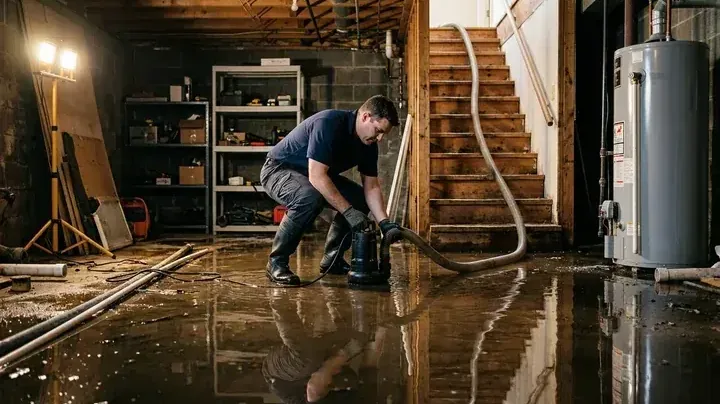
What every basement flooding cleanup job includes
Dispatch around the clock
Active water is treated as urgent at any hour. The response team rolls with extraction units, air movers and LGR dehumidifiers already on the truck.
Readings before tear-out
Moisture mapping and thermal imaging show where the water traveled inside walls and under floors, so only wet material comes out.
Dried to IICRC S500
Equipment is sized to the class of loss and stays until materials read within 2 to 4 points of a dry reference.
A file an adjuster can read
Timestamped photos, daily psychrometric logs and a line-item scope go into the claim file while the work happens.
First steps for basement flooding cleanup while help is on the way
Only what is safe, in this order:
- Find the water source. Rain, groundwater, a pipe or a drain decides the plan.
- Pump the lowest point. Submersible pumps draw the level down in stages.
- Strip wet materials. Soaked drywall, insulation and carpet are removed.
- Dry the structure. Air movers and dehumidifiers run until readings clear.
Dispatch runs every hour of the year, weekends and holidays included.
(888) 557-1733Pump out the basement nowWhat does basement flooding cleanup cost in Norwood, PA?
Finish level and water type set the cost. A bare basement with clean water is the lightest job, finished space adds removal and rebuild scope, and sewage or creek water moves the work into the top band.
Unfinished, clean water
- Pump-out
- Slab drying
- Readings kept
Finished basement
- Drywall and trim removal
- Sanitizing as needed
- Long equipment run
Sewage or creek water
- Protective gear
- Porous items removed
- Full documentation
Ranges are typical, not a quote: water category, square footage, material class and how fast drying started move the number most. The water damage cost calculator gives a closer range, and coverage depends on your own policy.
How basement flooding cleanup is handled, step by step
Locate
Source and water category are confirmed.
Pump
Water comes down from the lowest point.
Strip
Wet drywall and flooring are cut out.
Dry
Equipment runs until framing reads dry.
Water finds a lower level from several directions: rain runoff, groundwater, a failed pump, a broken pipe or a backed-up drain. In Norwood, where Darby Creek runs along the south and Muckinipattis Creek along the east, the source decides the plan, so the crew identifies it before choosing how to pump and dry.
How a basement cleanup runs
- Pump the lowest point first so water stops pressing on walls
- Cut out wet drywall, insulation and carpet that cannot be dried
- Wash and sanitize surfaces touched by gray or storm water
- Dry the slab, studs and sill plates with air movers and dehumidifiers
Finished space takes longer than bare concrete, because trim, paneling and cabinet kicks can hide moisture.
Deciding what stays
Wet insulation and drywall that sat in water usually go, while solid framing and concrete are dried and measured. Readings rather than appearance decide, since a wall that looks dry can still hold moisture and a stained one may already be below the dry standard.
Water in a lower level keeps spreading until it is pumped out.
(888) 557-1733Send the pump-out crewRelated work
A pump that stops during a storm is one trigger, covered under sump pump failure cleanup, while sewer water follows the sewage backup cleanup steps. The broader basement flooding process and the Norwood service hub show how each stage connects to extraction and drying.
Basement flooding cleanup across Norwood and nearby towns
Basement work covers the whole borough, from the Chester Pike corridor to homes near Darby Creek on the south and Muckinipattis Creek on the east, within ZIP 19074.
The same service nearby: basement flooding cleanup in Havertown, Glenolden, Folcroft.
Basement Flooding Cleanup questions, answered
Still dealing with it?
Water in a lower level keeps spreading until it is pumped out.
(888) 557-1733 Send the pump-out crewWhy is the source identified before pumping?
Rain runoff, groundwater and a broken pipe can keep adding water, and a drain backup changes the safety steps, so the cause shapes the whole plan.
Does basement water always mean sewage?
No. Many floods are clean or gray water, but any water that came through a floor drain or off the ground is treated as contaminated.
Should the pump-out be done all at once?
Usually not. Lowering the level in stages keeps walls and the slab from being stressed while the ground outside is still saturated.
Can finished walls be saved?
Sometimes, if the water was clean and the drying began early. Drywall and insulation that sat in water are normally removed so the cavity can dry.
Are the creeks the main concern in Norwood?
They are part of the picture, but cleanup depends on the actual source in each home, whether that is runoff, a pipe, a pump or a drain.
How is a dry basement confirmed?
Meters read the slab, sill plates and studs, and equipment is removed only after those readings match normal levels for the materials.
Pump first, strip second, dry until every reading says finished
The crew sets pumps, removes what cannot be saved and places air movers and dehumidifiers from a moisture map of the whole lower level.
(888) 557-1733Start the basement dry-out