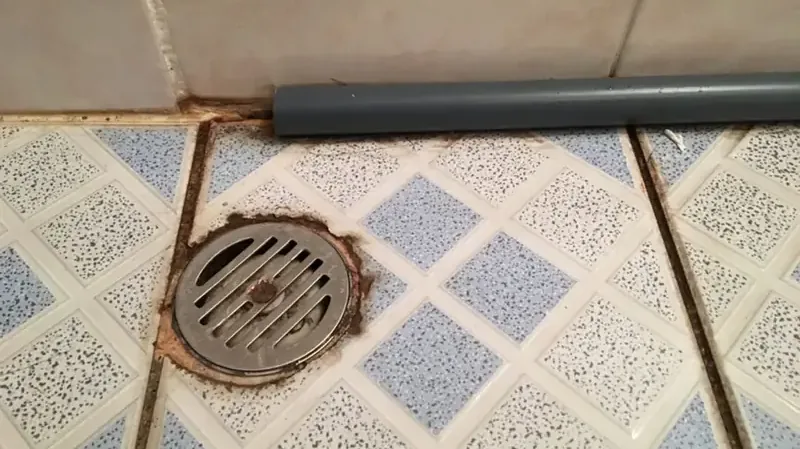
A sewer improvement project does not begin without a finding behind it. In Sharon Hill, smoke testing flagged the borough as a Hot Spot with sewer deficiencies, and that finding is a useful reason to learn what a sewage backup is and how it is cleaned.
Key takeaways
- Smoke testing a few years before May 2025 identified the borough as a Hot Spot, with sewer deficiencies on both public and private property.
- The borough says those deficiencies let stormwater get into the sanitary sewer system, which drives up the cost of sewer fees.
- DELCORA announced a wastewater collection project with construction slated to begin the week of May 5, 2025, offered at no cost to the borough or to residents who opt in.
- Nothing in the announcement says that any home has backed up, and a backup anywhere is cleaned as contaminated water, never with a household mop.
- The project does not say who repairs what on private property, so a plumber, the borough and an insurer are the people to ask about a specific address.
What the smoke testing found
Smoke testing sends harmless smoke through sewer pipes and watches where it escapes. The testing done a few years before May 2025 identified the borough as a Hot Spot, with deficiencies found on both public and private property.
The borough says those deficiencies let stormwater get into the sanitary sewer system, which drives up the cost of sewer fees.
- On the public side, deficiencies were found in borough sewer infrastructure.
- On the private side, deficiencies were also found on private property.
- The borough names stormwater in the sanitary system as the reason sewer fees climb.
The DELCORA project in plain terms
DELCORA, the Delaware County Regional Water Quality Control Authority, announced a project to improve the wastewater collection system in the borough. Construction was slated to begin the week of May 5, 2025.
MOR Construction was to complete the work, overseen by the Borough Engineer. The project includes improvements to borough-owned infrastructure on Elmwood Avenue and Jackson Avenue.
Nothing in the announcement says that any home has backed up. The project is about the system, and the household question starts only if water ever shows up in a drain.
- DELCORA said it would be in touch with residents whose properties were identified within the potential scope of work.
- Residents who want to take part sign on directly with DELCORA.
- The improvements were offered at no cost to the borough or to residents who opt in.
Why extra stormwater matters inside a sewer
A sanitary sewer carries household wastewater. When rain or groundwater gets in through cracks and loose joints, the pipes carry more than they were meant to, and a heavy storm adds to that strain.
Think of it as a plumbing system with a fixed capacity. Every gallon of rainwater that enters through a crack is a gallon of room taken from the wastewater it was built to carry.
Pipes under strain are more likely to push wastewater the wrong way wherever a weak spot exists. Nothing on record says that any Sharon Hill home has had a backup, but these are the conditions that make homeowners ask the question.
- Cracks in sewer pipes let groundwater seep in after rain.
- Loose joints and old connections can let stormwater find a path into the sanitary side.
- The extra flow raises the load that treatment and collection systems must carry, which is the reason the borough gives for higher sewer fees.
What a sewage backup does inside a home
A backup finds the lowest opening in the house, usually a floor drain, a basement toilet or a tub, whatever the age of the building. The borough says most homes are over 50 years old and many are 75 to 100 years old or more.
The water is classed as Category 3 because it can carry bacteria and viruses. The sewage backup cleanup crew works in protective gear and treats the whole area as contaminated.
- Standing water is extracted with pumps and wet vacuums.
- Porous materials that soaked it up, such as carpet, pad and low drywall, are removed.
- Hard surfaces are cleaned, then disinfected with products suited to sewage.
- Remaining framing and subfloor are dried and checked with moisture meters.
- Contents that touched the water are sorted into discard and clean, and soft items such as rugs and stuffed furniture are rarely saved.
Twins and row homes: the shared wall question
Housing here is a mix of large single homes, twins and row homes. In a twin or a row home, water that gets under a floor or into a wall can move toward the wall shared with the next house.
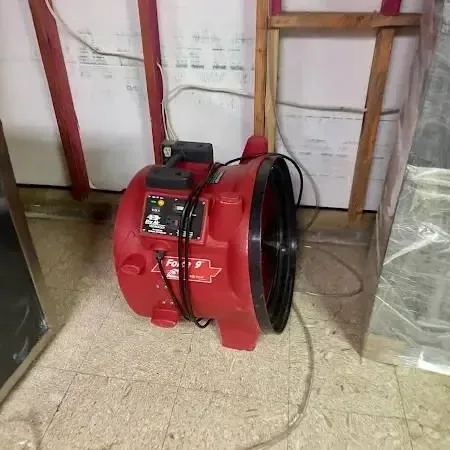
The drying team checks both sides of that wall with a moisture meter and tells the household so the neighbor can check too. Follow-up structural drying in Sharon Hill is planned around where the readings show the moisture traveled.
Floors above the loss matter too. Water that has gone through a ceiling or down a stack can show up two rooms away from the opening it used.
First steps when a drain backs up
The first minutes after a backup matter less than the first decisions. The household's job is to stop adding water and to keep people out of the area.
- Stop using sinks, tubs, toilets, washers and dishwashers until the cause is found.
- Keep children, pets and anyone with a weak immune system out of the room.
- Do not run a household vacuum on the water.
- Photograph the water and everything it touched before anything is moved.
- Call a plumber to find the cause, and call a restoration crew for the water.
Who answers the question of responsibility
The borough's notice says deficiencies sit on both public and private property, but it does not say who repairs what for a particular address. That is a question for a plumber, the borough and an insurer, in that order.
For a loss that has already happened, the cleanup does not wait on that answer. The local sewage backup cleanup crew serving Sharon Hill keeps the photos and readings that the insurer will ask for later.
Questions
Does the DELCORA project mean my home will back up?
No. The announcement describes sewer improvements and says nothing about a backup in any home. It is useful as context for what the borough found in its smoke testing.
Do I have to take part in the project?
No. The announcement says residents who want to take part sign on directly with DELCORA, and it was offered at no cost to those who opt in.
Is sewage backup water the same as stormwater?
No. Sewage backup water is Category 3 and can carry bacteria and viruses. Stormwater that enters a house is also treated as contaminated, but a sewage backup is handled with more protective gear and stronger disinfection.
Can I clean a small backup myself?
A very small spill on a hard floor can be cleaned with gloves, boots and a disinfectant made for the job. Anything that reached carpet, drywall or a larger area calls for a restoration crew.
What should I keep for the insurer?
Keep photos of the water and the damage, a note of when it started, any plumber's invoice and the restoration crew's moisture readings. Ask the insurer whether sewer backup coverage is part of the policy.
What does Category 3 mean?
Category 3 is the most contaminated class of water in restoration standards. It includes sewage and floodwater, and it means porous materials that touched it are removed and the area is disinfected before drying.