Structural Drying and Dehumidification in Glenolden, PA
Water that looks gone often is not. Air movers and dehumidifiers pull moisture out of framing, subfloor and drywall while meters track the drop, so repairs begin only when the structure is truly dry.
(888) 557-1733Plan the drying with a restoration pro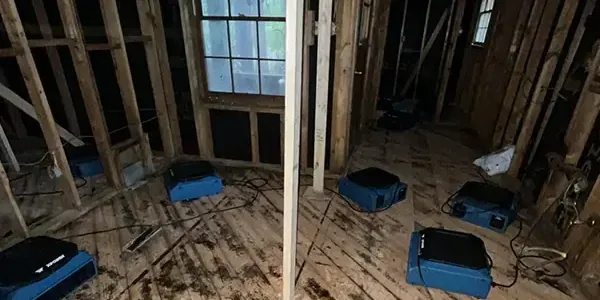
What every structural drying and dehumidification job includes
Dispatch around the clock
Active water is treated as urgent at any hour. The response team rolls with extraction units, air movers and LGR dehumidifiers already on the truck.
Readings before tear-out
Moisture mapping and thermal imaging show where the water traveled inside walls and under floors, so only wet material comes out.
Dried to IICRC S500
Equipment is sized to the class of loss and stays until materials read within 2 to 4 points of a dry reference.
A file an adjuster can read
Timestamped photos, daily psychrometric logs and a line-item scope go into the claim file while the work happens.
First steps for structural drying and dehumidification while help is on the way
Only what is safe, in this order:
- Keep doors closed. Closed rooms let dehumidifiers work efficiently.
- Leave equipment running. Fans and dehumidifiers must run continuously.
- Check the thermostat. Warm air dries faster, so keep the heat on.
- Log what you see. Note any new stains for the crew.
Dispatch runs every hour of the year, weekends and holidays included.
(888) 557-1733Plan the drying with a restoration proWhat does structural drying and dehumidification cost in Glenolden, PA?
Clean water in a single room usually runs $1,000 to $3,500, a finished basement or several rooms $3,500 to $9,000, and dense materials or Category 3 water $9,000 to $25,000 or more once extended equipment time is added.
One room, clean water
- Air movers placed
- Dehumidifier running
- Daily readings
Finished basement or several rooms
- Wall cavity drying
- Floor mat system
- Drying logs
Dense materials or Category 3
- Extended equipment run
- Sanitizing
- Final clearance readings
Ranges are typical, not a quote: water category, square footage, material class and how fast drying started move the number most. The water damage cost calculator gives a closer range, and coverage depends on your own policy.
How structural drying and dehumidification is handled, step by step
Map
Meters mark every wet surface
Place
Set equipment by room volume
Monitor
Log readings at each visit
Release
Remove equipment at dry reference
Drying is a physics problem. Warm, moving, dehumidified air pulls moisture out of materials, and machines are chosen to suit the volume of each room. Too little leaves pockets wet; too much wastes power and time.
Why homes dry differently
Glenolden grew from 1,944 residents in 1920 to a peak of 8,697 in 1970, and development of Glenolden Manor began in 1903, so homes span several building eras. Older framing, newer drywall and mixed finishes can each release moisture at a different pace.
The equipment in use
- Fans push dry air across wet surfaces
- Dehumidifiers pull vapor out of the room
- Hoses and mats draw water from beneath floors
- Plastic sheeting isolates the wet zone
Machines are repositioned as readings fall, which is why the layout changes from one visit to the next.
Wet framing needs more than a fan from the hardware store.
(888) 557-1733Put meters on the framingHow dry is dry?
Meters are compared against a dry reference taken from an unaffected room of the same material. Equipment comes out only when every reading matches it. The earlier stage is covered under water extraction, and the structural drying main page lists ranges.
Structural drying and dehumidification across Glenolden and nearby towns
Drying equipment goes into homes and businesses across the borough, from the streets around Glenolden Station to the Glenolden Manor and Llanwellyn areas and the blocks along Chester Pike.
The same service nearby: structural drying and dehumidification in Havertown, Norwood, Folcroft.
Related water damage services
Structural Drying and Dehumidification questions, answered
Still dealing with it?
Wet framing needs more than a fan from the hardware store.
(888) 557-1733 Put meters on the framingWhy do fans run for days?
Moisture inside framing and subfloor leaves slowly. Continuous airflow keeps pulling it to the surface until readings match a dry reference.
Are the dehumidifiers loud?
They hum like a window air conditioner, and air movers add steady fan noise. The sound means the work is progressing.
Will the electric bill go up?
Yes, for a few days, since several machines run around the clock. Keep a note of the drying period and ask the adjuster whether the extra usage can be included.
Can drying be done without removing drywall?
Sometimes. Clean water caught early can be dried through small holes or behind baseboards, while wet insulation or contaminated materials must come out.
How do I know the structure is dry?
Readings are compared with a dry reference, and the logs show the drop day by day. Appearance and feel are not reliable.
What happens if drying stops too early?
Moisture left in framing can feed mold growth in a day or two once it turns warm and damp again, and wood floors can cup or buckle.
Dry the structure to a number, not a guess
Tell the drying team which rooms were wet and for how long, and the equipment layout and monitoring steps can be planned from that.
(888) 557-1733Plan the dry-down